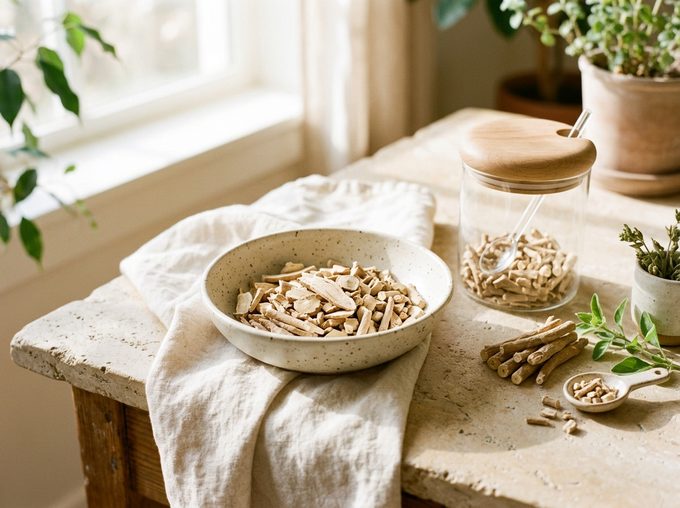
✦ HERBAL TRADITION • ROOTS, BERRIES & WOODLAND POLYPORES
Adaptogens & Vitality
Hardy roots, five-flavor berries, and functional mushrooms from Ayurvedic, Siberian, and East Asian traditions prized for steady resilience.
🔬 Phytochemical Mechanism
Originally defined by Soviet pharmacologist Dr. Israel Brekhman in 1947–1968, true adaptogens must be (1) non-toxic at normal doses, (2) produce a non-specific state of resistance to physical, chemical, or biological stress, and (3) have a normalizing ('amphoteric') influence on the hypothalamic-pituitary-adrenal (HPA) axis via triterpenoid saponins, withanolides, phenylpropanoids (rosavins), or fungal beta-glucans.
🌡️ Extraction & Steeping Protocol
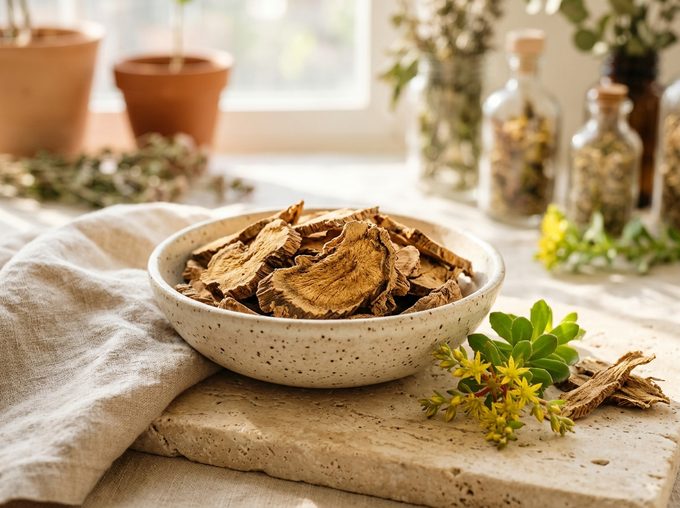
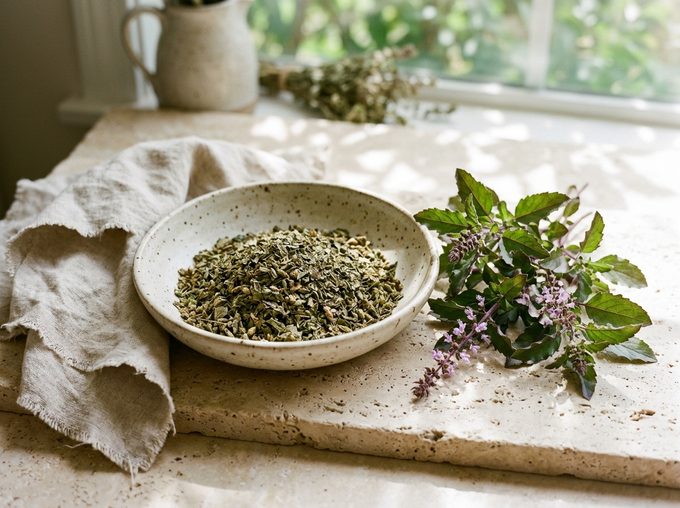
Dense roots (Ashwagandha, Eleuthero, Astragalus) and chitin-walled mushrooms (Reishi, Lion's Mane) require a 20-to-35-minute covered stovetop simmer (decoction). Only leafy Holy Basil (Tulsi) infuses in a standard 8-minute pour-over.
👅 Organoleptic Palate Signature
Complex and full-bodied: starchy-earthy (Ashwagandha), rose-astringent (Rhodiola), sweet-legume (Astragalus), five-flavored tart-pungent (Schisandra), or woody-bitter (Reishi).
TRADITION COMPARISON TABLE
All 8 Adaptogens & Vitality Compared by Compound & Steep Ratio
| Botanical & Binomial | Plant Part | Key Phytochemicals | Organoleptic Palate & Aroma | Dose & Steep (8 oz) |
|---|---|---|---|---|
| Ashwagandha Root Withania somnifera |
Dried starchy root | Withanolides (Withaferin A, Withanolide D), Alkaloids | Earthy, starchy, slightly malty, and mildly bitter-astringent with a warm root body that pairs naturally with milk, ghee, cardamom, and cinnamon. | 3 g – 5 g 205°F–212°F low simmer · Simmer covered 15–20 min in 10 oz water, then strain |
| Rhodiola Rosea Rhodiola rosea |
Golden rhizome & root | Rosavin, Rosarin, Rosin, Salidroside, Tyrosol | Astringent, brisk, and slightly bitter-mineral with a distinctive, natural Bulgarian rose-water aroma when freshly cut or steeped. | 1.5 g – 2.5 g 200°F–205°F · Simmer gently 10 min or steep covered 15–20 min |
| Holy Basil (Tulsi) Ocimum tenuiflorum |
Aerial leaves & purple flower spikes | Eugenol, Ursolic acid, Rosmarinic acid, Ocimenosides | Warming, spicy-clove, peppery, and subtly floral-citrus with a complex, tea-like body. | 2 g – 3 g (1.5 tbsp & blossom) 200°F · 7–10 min covered |
| Eleuthero Root Eleutherococcus senticosus |
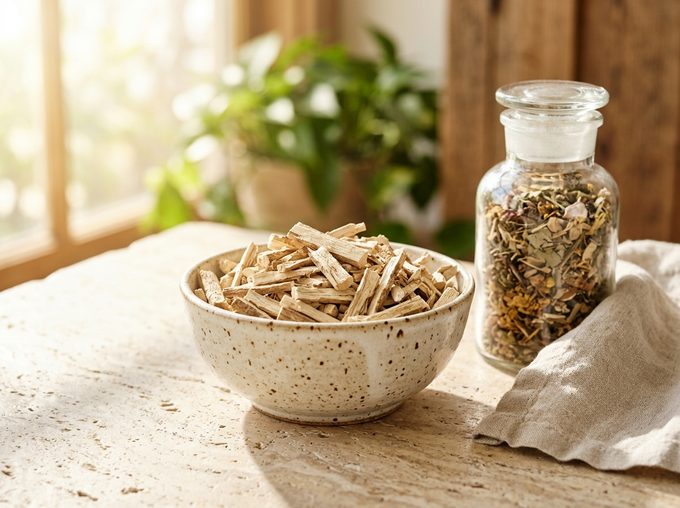
Dried root & root bark | Eleutherosides (B & E), Polysaccharides, Phenolic compounds | Woody, sweet-earthy, and mildly bitter-acrid with a clean forest-bark finish. | 3 g – 6 g 205°F–212°F low simmer · Simmer covered 20–25 min in 12 oz water |
| Schisandra Berry Schisandra chinensis |
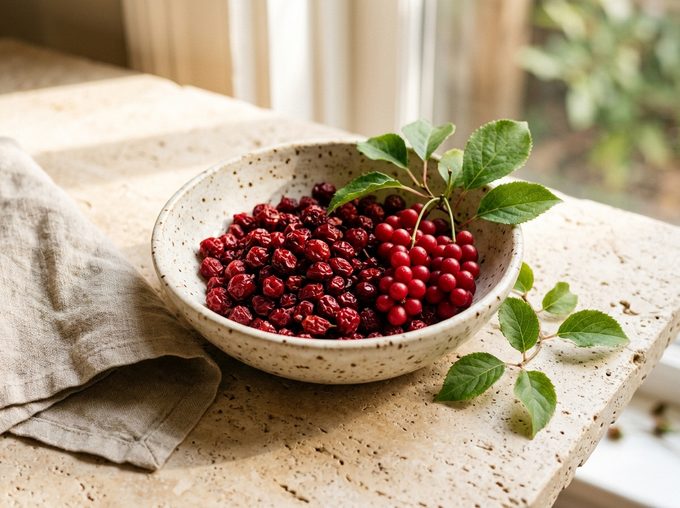
Whole dried ripe berries | Schisandrins, Gomisins, Deoxyschisandrin, Organic acids | An extraordinary 'five-flavor' sensory burst: intensely tart-cranberry sour and salty at first, followed by sweet fruitiness, resinous pine-pepper, and a subtle bitter finish. | 3 g – 5 g (1 tbsp whole) 195°F–205°F · Simmer gently 10–12 min or steep covered 20 min |
| Astragalus Root Astragalus membranaceus |
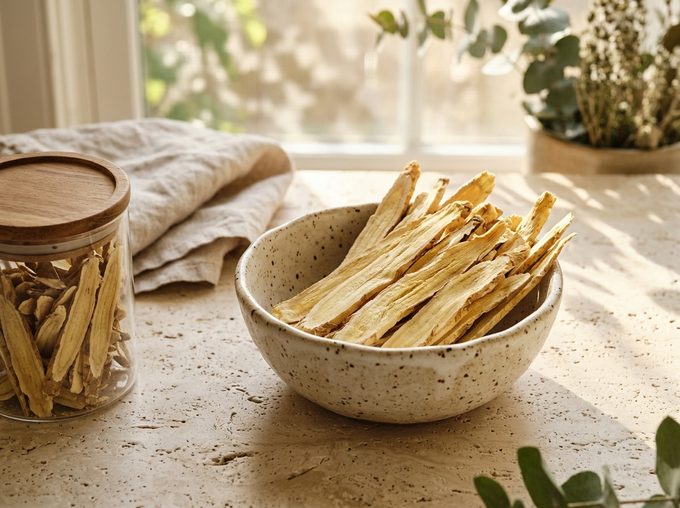
Sliced dried 4-year root | Astragalosides (I–VII), Calycosin, Polysaccharides, Saponins | Mildly sweet, starchy, and pleasantly legume-earthy, reminiscent of mild roasted parsnip or sweet yellow split peas. | 5 g – 9 g 205°F–212°F low simmer · Simmer covered 25–35 min in water or soup stock |
| Red Reishi Ganoderma lucidum |
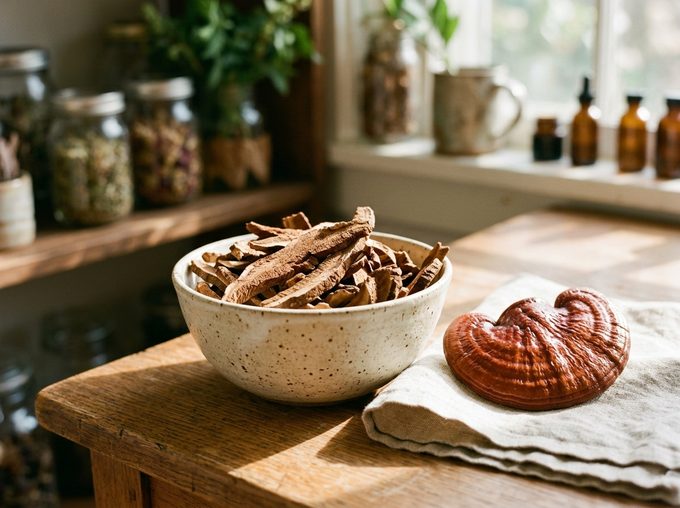
Fruiting body slices | Beta-D-glucans, Ganoderic acids (Triterpenes), Ergosterol | Intensely woody, earthy, and distinctly bitter with a deep umami forest-floor finish. | 4 g – 6 g 205°F–212°F low covered simmer · Simmer 35–45 min in 14 oz water |
| Lion's Mane Hericium erinaceus |
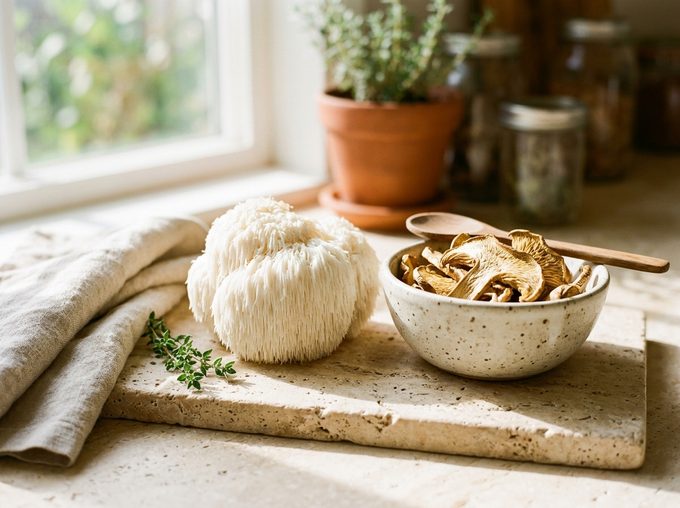
Fruiting body | Hericenones, Erinacines, Beta-glucan polysaccharides | Mild, savory, sweet-umami, and remarkably seafood-like. | 3 g – 5 g 200°F–208°F gentle simmer · Simmer 15–20 min in water, broth, or coffee |
TRADITION FAQ
Frequently Asked Questions About Adaptogens & Vitality
Are all adaptogens energizing, or are some calming?
Adaptogens sit on a spectrum: Rhodiola rosea and Eleuthero are brisk and energizing (best taken in the morning), Holy Basil and Schisandra are balanced for midday, and Ashwagandha and Reishi are grounding and calming (suited to evening use).
Why do mushrooms like Reishi and Lion's Mane require hot-water extraction?
Fungal cell walls are composed of chitin, an indigestible structural polymer. Simmering for 30+ minutes (or using a pre-extracted fruiting-body powder) unlocks the bioactive (1→3),(1→6)-beta-D-glucans.
EXPLORE ALL 7 TRADITIONS & ENERGETICS TOOLS