Red Reishi
Lingzhi • Lacquered Woodland Polypore of Serenity & Longevity Lore.
Explore the common forms, learn a little about the plant, and choose what suits your cupboard.
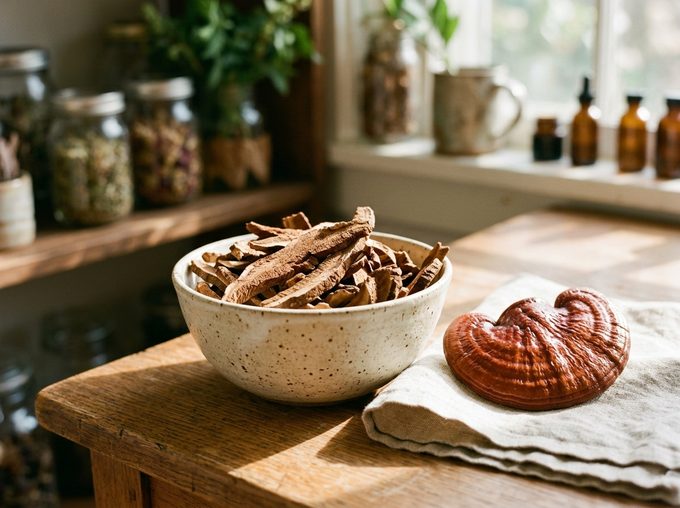
Whole dried red reishi for steeping, blending, and cupboard jars.
A little about red reishi.
The plant
Intensely woody, earthy, and distinctly bitter with a deep umami forest-floor finish. Native to Temperate Hardwood Forests Worldwide (Ganodermataceae).
The forms
Most often prepared as a slow dual-stage decoction using 4 g – 6 g (3 to 4 dried sliced strips or 1.5 tbsp cut conk) at 205°F–212°F low covered simmer (Simmer 35–45 min in 14 oz water (minimum 30 min to break chitin)).
Before you choose
Check the label for the Latin name (Ganoderma lucidum), and choose the form that suits your cupboard.
Traditional uses & research +
Botanical taxonomy: Ganoderma lucidum (Ganodermataceae) · Tradition: Adaptogens & Vitality · Key constituents: Beta-D-glucans, Ganoderic acids (Triterpenes), Ergosterol.
Curated collections: Adaptogenic Roots, Berries & Fungi · Evening Calm & Bedtime Infusions · Seasonal almanac: November Almanac (Deep Autumn Adaptogens & Woodland Fungi).
Traditional background: Celebrated in Taoist art and classical herbals as Lingzhi ('Mushroom of Spiritual Potency'), wild red reishi grows on decaying hardwood logs with a natural glossy red-amber sheen.
Everyday & kitchen uses: Simmered as thin woody slices into dark herbal coffee alternatives, cacao elixirs, or savory mushroom stocks.
Standard preparation methods (compare all 50 steeping temperatures):
- Slow Dual-Stage Decoction (4 g – 6 g (3 to 4 dried sliced strips or 1.5 tbsp cut conk) at 205°F–212°F low covered simmer): Simmer 35–45 min in 14 oz water (minimum 30 min to break chitin)
- Reishi-Cacao Evening Elixir (8 oz strained reishi decoction + 1 tbsp raw cacao + 1 tsp maple syrup + cinnamon at Whisk warm): Roasty cacao and cinnamon naturally complement reishi's bitterness
- Dual-Extract Tincture (Water + Alcohol) (Alcohol maceration of marc + hot water decoction combined to 25%–30% ABV at Two-step extraction): Alcohol extracts bitter triterpenes; hot water extracts beta-glucans
Cautions & interactions +
Who should use caution: Because Reishi polysaccharides and adenosine derivatives have mild anti-platelet (blood-thinning) and blood-pressure-modulating properties, discontinue high-dose extracts 2 weeks prior to surgery and consult a physician if taking anticoagulants or immunosuppressants.
Species & lookalike verification: Red Reishi / Lingzhi (Ganoderma lucidum and the closely related East Asian Ganoderma lingzhi) grows on hardwoods, whereas Eastern North American Hemlock Varnish Shelf (Ganoderma tsugae) grows on conifers. When buying powdered Reishi, verify '100% Fruiting Body (Conk)'—many cheap supplements are 'mycelium on grain' (MOG), which can be up to 60% undigested brown rice or oat starch with minimal bitter triterpenes.
Cupboard storage (amber glass guide): Store dried fruiting body slices in airtight glass with a food-safe desiccant pack.
Sources & further reading +
Why is real Reishi mushroom supposed to taste bitter?
Reishi's bitter taste comes directly from over 100 unique ganoderic and lucidenic acids (triterpenoids) concentrated in the fruiting body and spore layer. In fact, bitterness is one of the fastest organoleptic tests to distinguish genuine fruiting-body Reishi from starch-heavy myceliated grain powders.
Why do you have to boil Reishi slices for at least 30 minutes?
Unlike plants—whose cell walls are made of cellulose—mushroom cell walls are built from chitin, the same tough structural polymer found in crab shells. A quick 5-minute tea steep cannot break chitin; simmering sliced Reishi for 35–45 minutes releases water-soluble (1→3),(1→6)-β-D-glucans.
What does a 'Dual Extract' of Reishi mean?
Reishi has two main classes of active compounds with opposite solubilities: its immunomodulating beta-glucan polysaccharides dissolve only in hot water, while its calming ganoderic acid triterpenes dissolve best in ethanol (alcohol). A dual extract combines both extractions.
What are the best herbs and spices to blend with Reishi to balance its bitterness?
Roasted dandelion root, cacao nibs, Ceylon cinnamon, star anise, ginger, and a touch of licorice root or maple syrup transform Reishi's woody bitterness into a rich, mocha-like dark brew.
Companion Moss & Thyme guides & tools:
- Herbarium Journal: Evening Botanical Tea Rituals & Blending →
- Equipment Guide: Best Loose-Leaf Tea Infusers & Gooseneck Kettles →
- Interactive Calculator: Interactive 3-Part Tea Blend Synergy Builder →
Botanical references:
- Royal Botanic Gardens, Kew — Plants of the World Online: Ganoderma lucidum Taxonomic Record ↗
- PubChem / NIH National Library of Medicine: Phytochemical Profile (Beta-D-glucans) ↗
- European Medicines Agency (EMA) HMPC & German Commission E Herbal Monographs.
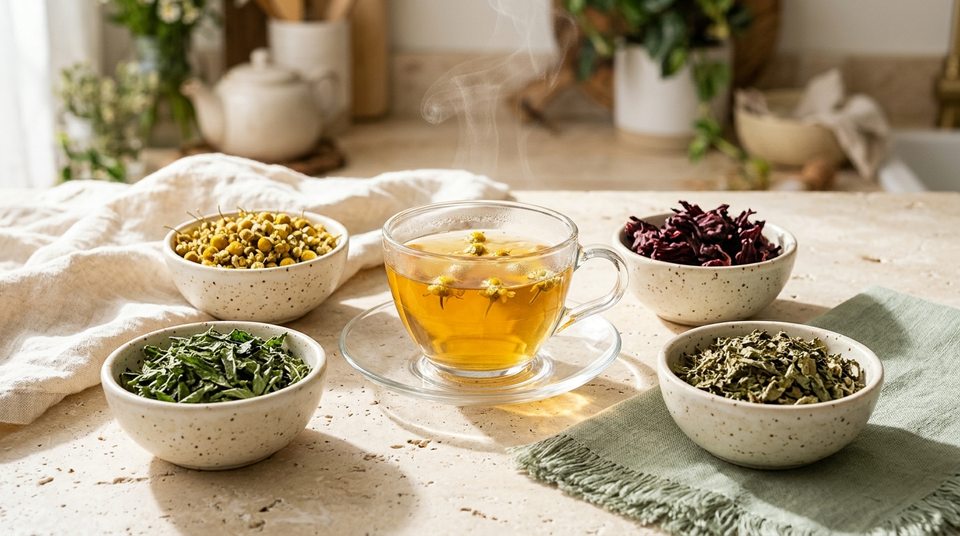
See the herb in context.
Watch our video guide The Most Powerful Herbs in the World, Explained and explore the plants it introduces.
Explore another herb.