Ceylon Cinnamon
True Cinnamon • Delicate Multi-Layered Inner Bark Quills of Sri Lanka.
Explore the common forms, learn a little about the plant, and choose what suits your cupboard.
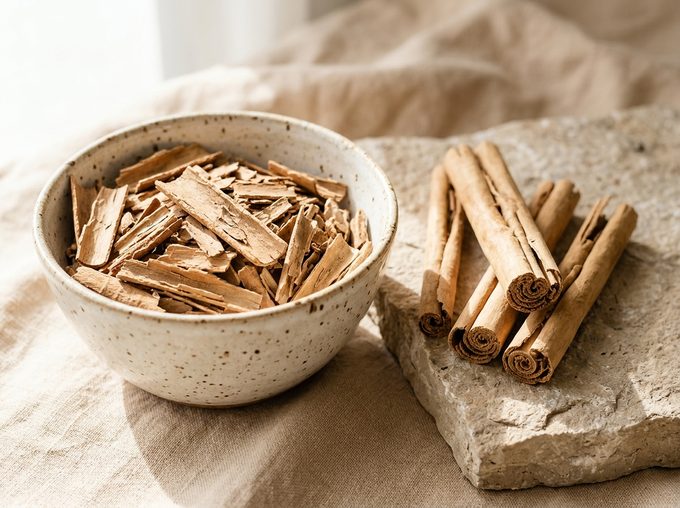
Dried ceylon cinnamon pieces for simmering, decoctions, and jars.
A little about ceylon cinnamon.
The plant
Delicate, warm, citrus-floral, and complexly sweet without the harsh, tongue-burning red-hot bite of common supermarket cassia. Native to Sri Lanka (Ceylon) (Lauraceae (Laurel Family)).
The forms
Most often prepared as a simmered bark quill decoction using 1 whole 3-inch Ceylon quill (crumbled easily by hand) in 10 oz water at 205°F–212°F covered simmer (Simmer 12–15 min (releases natural mucilage & cinnamaldehyde)).
Before you choose
Check the label for the Latin name (Cinnamomum verum), and choose the form that suits your cupboard.
Traditional uses & research +
Botanical taxonomy: Cinnamomum verum (Lauraceae (Laurel Family)) · Tradition: Digestive & Carminative · Key constituents: Cinnamaldehyde, Eugenol, Proanthocyanidins (Ultra-low Coumarin).
Curated collections: Digestive Bitters & Warming Spices · Adaptogenic Roots, Berries & Fungi · Seasonal Harvest & Winter Apothecary · Beginner's Home Apothecary Starter Shelf · Seasonal almanac: January Almanac (Midwinter Roots & Pine Needles) · December Almanac (Solstice Resins, Bark Quills & Evergreen).
Traditional background: Prized in the ancient world above gold and silver, true Sri Lankan cinnamon is crafted by peeling paper-thin ribbons of inner bark and telescoping them by hand into multi-layered quills.
Everyday & kitchen uses: Crumbled by hand into herbal teas, simmered in elderberry syrup and spiced ciders, or ground fresh for baking.
Standard preparation methods (compare all 50 steeping temperatures):
- Simmered Bark Quill Decoction (1 whole 3-inch Ceylon quill (crumbled easily by hand) in 10 oz water at 205°F–212°F covered simmer): Simmer 12–15 min (releases natural mucilage & cinnamaldehyde)
- Ceylon Cinnamon & Apple-Peel Tisane (1 crumbled Ceylon quill + 1 tsp rosehips + 2 slices apple at 205°F covered steep): Steep 12 min
- Freshly Ground Spice (Crumble brittle Ceylon quills into a coffee grinder or brass mortar at Grind effortlessly): Unlike rock-hard Cassia, Ceylon bark grinds in seconds without damaging blades
Cautions & interactions +
Who should use caution: WHY CEYLON MATTERS FOR DAILY USE: Coumarin (abundant in cheap Cassia cinnamon) can cause reversible liver enzyme elevation (hepatotoxicity) if consumed in daily medicinal/supplement doses (e.g., 1–2 teaspoons of Cassia daily). Switching to True Ceylon Cinnamon (Cinnamomum verum) allows you to enjoy daily cinnamon teas, oatmeal, and Golden Milk with 250x less coumarin!
Species & lookalike verification: CRITICAL SPECIES & COUMARIN DISTINCTION: 90% of supermarket 'cinnamon' sold in North America is actually Cassia (Cinnamomum cassia / C. aromaticum or Indonesian Korintje Cinnamomum burmannii)—a thick, single-layer, rock-hard hollow scroll of dark reddish-brown bark that contains high levels of coumarin (0.4% to 1.0%+). True Sri Lankan Ceylon Cinnamon (Cinnamomum verum, syn. Cinnamomum zeylanicum) is made from paper-thin inner bark layers rolled together like a multi-layered Cuban cigar cross-section, is pale tan-brown, crumbles effortlessly between your fingers, and contains trace/negligible coumarin (<0.004%).
Cupboard storage (amber glass guide): Store whole quills in tall glass jars away from light.
Sources & further reading +
How can you tell True Ceylon Cinnamon apart from Cassia Cinnamon in 3 seconds?
Look at the cross-section of the stick and squeeze it: Cassia is a single, thick, rock-hard piece of bark curled inward from both sides (you need a hammer to break it). True Ceylon Cinnamon (Cinnamomum verum) is pale tan, filled with multiple concentric paper-thin layers like a rolled cigar, and crumbles easily between your bare fingers.
Why is Ceylon Cinnamon safer than regular supermarket cinnamon for daily tea or smoothies?
Supermarket Cassia cinnamon contains up to 1% coumarin, a natural compound that can stress the liver if taken in large daily amounts. True Ceylon Cinnamon contains less than 0.004% coumarin—about 250 times less than Cassia—making Ceylon the only species recommended for daily wellness infusions.
Why does Ceylon Cinnamon taste milder than the cinnamon in cinnamon rolls?
Cassia's volatile oil is 95% pure cinnamaldehyde, which hits the tongue with a one-note 'red-hot fireball' burn. Ceylon Cinnamon's volatile oil (~65% cinnamaldehyde balanced with eugenol, linalool, and caryophyllene) tastes softer, sweeter, and slightly citrus-clove fragrant.
Why does simmered Ceylon Cinnamon tea become slightly sweet and silky on its own?
Simmering a crumbled Ceylon quill for 12–15 minutes extracts both sweet trans-cinnamaldehyde and water-soluble bark arabinoxylan mucilage, making the tea taste naturally sweetened even with zero sugar.
Companion Moss & Thyme guides & tools:
- Herbarium Journal: Covered Infusions vs. Simmered Decoctions →
- Equipment Guide: Best Mortars, Pestles & Apothecary Grinders →
- Interactive Calculator: Infusion vs. Decoction & Safety Checker →
Botanical references:
- Royal Botanic Gardens, Kew — Plants of the World Online: Cinnamomum verum Taxonomic Record ↗
- PubChem / NIH National Library of Medicine: Phytochemical Profile (Cinnamaldehyde) ↗
- European Medicines Agency (EMA) HMPC & German Commission E Herbal Monographs.
See the herb in context.
Watch our video guide The Most Powerful Herbs in the World, Explained and explore the plants it introduces.
Explore another herb.