White Pine Needle
Five-Needle Evergreen Forest Tea Rich in Citrus-Pine Aromatics.
Explore the common forms, learn a little about the plant, and choose what suits your cupboard.
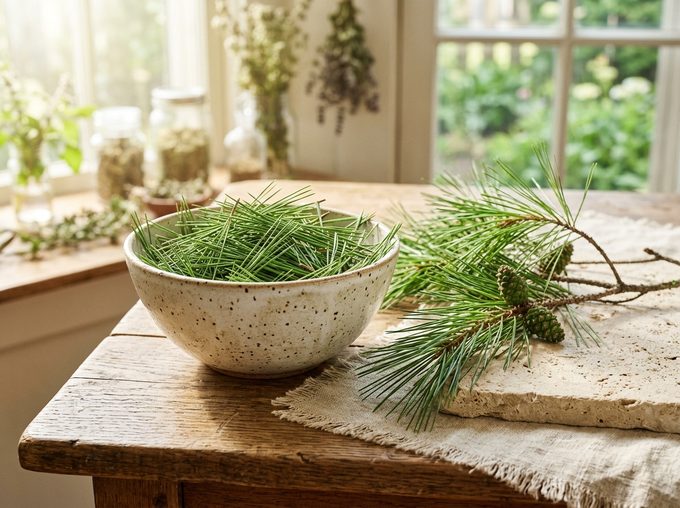
Whole cut-and-sifted white pine needle leaves for steeping and blending.
A little about white pine needle.
The plant
Crisp, bright, evergreen-citrus, and remarkably sweet-lemony when steeped below boiling. Native to Eastern North America (Pinaceae).
The forms
Most often prepared as a sub-boiling citrus-forest infusion (best) using 4 g – 6 g (2 tbsp finely chopped green needles) in 10 oz water at 175°F–185°F (80°C–85°C) — DO NOT BOIL (Steep covered 10–15 min; strain and add a squeeze of lemon or maple syrup).
Before you choose
Check the label for the Latin name (Pinus strobus), and choose the form that suits your cupboard.
Traditional uses & research +
Botanical taxonomy: Pinus strobus (Pinaceae) · Tradition: Nutritive & Berry Tonics · Key constituents: Alpha-pinene, Beta-pinene, Shikimic acid, Vitamin C, Flavonoids.
Curated collections: Aromatic Steams & Soothing Leaves · Seasonal Harvest & Winter Apothecary · Sacred Resins & Forest Aromatics · Seasonal almanac: January Almanac (Midwinter Roots & Pine Needles) · December Almanac (Solstice Resins, Bark Quills & Evergreen).
Traditional background: Known to the Haudenosaunee (Iroquois) as the Tree of Peace, Eastern White Pine is easily identified by its soft, flexible needles growing in bundles (fascicles) of five—five letters in W-H-I-T-E.
Everyday & kitchen uses: Chopped and steeped in 180°F water with honey and lemon for a fragrant winter forest tea, or simmered as a stovetop room aromatic.
Standard preparation methods (compare all 50 steeping temperatures):
- Sub-Boiling Citrus-Forest Infusion (Best) (4 g – 6 g (2 tbsp finely chopped green needles) in 10 oz water at 175°F–185°F (80°C–85°C) — DO NOT BOIL): Steep covered 10–15 min; strain and add a squeeze of lemon or maple syrup
- Winter Stovetop Room Aromatic (1/2 cup pine needles + 2 cinnamon sticks + 1 sliced orange + 4 cloves at Low uncovered simmer pot): Fills the home with natural woodland terpene aroma
- Pine Needle Infused Vinegar (Pack clean dry needles into a jar; cover with apple cider vinegar at Steep 3 weeks in dark cabinet): Use in woodland vinaigrettes or herbal shrubs
Cautions & interactions +
Who should use caution: PREGNANCY & SPECIES WARNING: Strictly verify 5-needle Pinus strobus. Even with true White Pine, concentrated pine needle extracts are avoided during pregnancy as a precaution (ponderosa pine needles contain isocupressic acid, a known livestock abortifacient; while Pinus strobus has a different terpene profile, herbalists avoid all conifer needle teas during pregnancy).
Species & lookalike verification: CRITICAL FORAGING & TOXIC TREE IDENTIFICATION: Eastern White Pine (Pinus strobus) is the ONLY native pine in eastern North America with exactly FIVE soft, flexible, bluish-green needles per bundle (fascicle)—remember: 5 letters in W-H-I-T-E = 5 needles per bundle! NEVER confuse White Pine with: (1) English/Japanese Yew (Taxus baccata / Taxus cuspidata)—Yew has flat, dark-green single needles attached directly to the twig (not in bundles of 5) and red berry-like arils instead of woody pinecones; Yew contains lethal taxine alkaloids and is deadly poisonous! (2) Ponderosa Pine (Pinus ponderosa, 2–3 long stiff needles per bundle), Lodgepole Pine (Pinus contorta), or Norfolk Island Pine (Araucaria heterophylla), which should not be steeped internally.
Cupboard storage (amber glass guide): Keep dried needles in sealed dark glass in a cool cabinet.
Sources & further reading +
How do you positively identify Eastern White Pine (Pinus strobus) every single time?
Pull off one tiny needle cluster (fascicle) where it joins the twig and count the needles inside that single papery sheath: Eastern White Pine ALWAYS has 5 soft, flexible needles per bundle (5 letters in W-H-I-T-E). Furthermore, it produces woody hanging pinecones—never red berries (which belong to toxic Yew bushes).
Why did my White Pine needle tea taste like turpentine instead of sweet citrus?
Because the water was boiling! Boiling 212°F water extracts heavy resinous pitch and oxidizes alpha-pinene while destroying delicate vitamin C. Instead, chop the needles into 1/2-inch pieces, pour 180°F water (just when small bubbles form on the bottom of the kettle) over them, and steep covered for 10 minutes—the result is pale golden and tastes like bright lemon-forest mist.
Why should you chop pine needles with kitchen shears before steeping?
Whole pine needles are coated in a waterproof waxy cuticle designed to prevent moisture loss during sub-zero winters. Snipping the needles crosswise into 3 or 4 segments exposes the open green interior channels so 180°F water can extract the water-soluble vitamin C, shikimic acid, and bioflavonoids.
Are winter White Pine needles higher in Vitamin C than summer needles?
Yes—botanical analyses show that evergreen Pinus strobus needles actually increase their intracellular concentration of ascorbic acid and protective polyphenols during cold winter months to prevent freezing oxidative damage in their chloroplasts.
Companion Moss & Thyme guides & tools:
- Herbarium Journal: Evening Botanical Tea Rituals & Blending →
- Equipment Guide: Best Loose-Leaf Tea Infusers & Gooseneck Kettles →
- Interactive Calculator: Interactive 3-Part Tea Blend Synergy Builder →
Botanical references:
- Royal Botanic Gardens, Kew — Plants of the World Online: Pinus strobus Taxonomic Record ↗
- PubChem / NIH National Library of Medicine: Phytochemical Profile (Alpha-pinene) ↗
- European Medicines Agency (EMA) HMPC & German Commission E Herbal Monographs.
See the herb in context.
Watch our video guide The Most Powerful Herbs in the World, Explained and explore the plants it introduces.
Explore another herb.