Garden Sage
Velvety Silver-Green Leaf of Classic European Herbals.
Explore the common forms, learn a little about the plant, and choose what suits your cupboard.
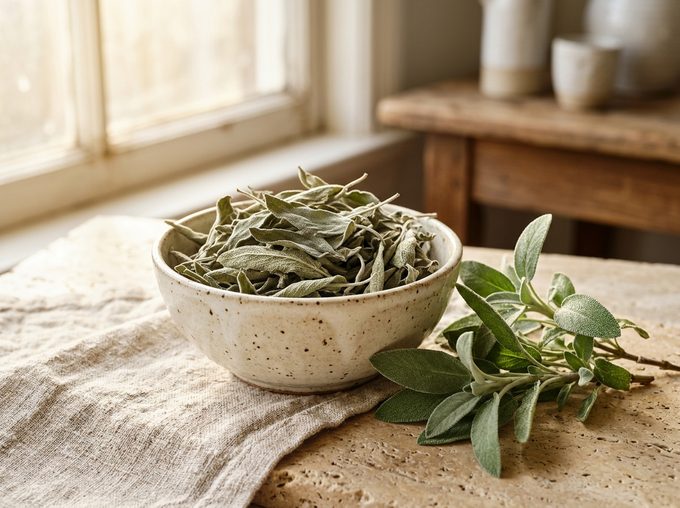
Whole cut-and-sifted garden sage leaves for steeping and blending.
A little about garden sage.
The plant
Savory, resinous, and slightly bitter-astringent with warm camphor, pine, and eucalyptus undertones and a velvety mouthfeel. Native to Dalmatian Coast, Mediterranean (Lamiaceae (Mint Family)).
The forms
Most often prepared as a standard leaf infusion using 1.5 g – 2 g (1 tbsp rubbed leaf) at 200°F (93°C) (6–8 min covered (longer steeps increase tannin astringency)).
Before you choose
Check the label for the Latin name (Salvia officinalis), and choose the form that suits your cupboard.
Traditional uses & research +
Botanical taxonomy: Salvia officinalis (Lamiaceae (Mint Family)) · Tradition: Volatile Aromatics · Key constituents: Rosmarinic acid, Camphor, Cineole, Salvianolic acids.
Curated collections: Mediterranean Culinary & Hearth Herbs · Aromatic Steams & Soothing Leaves · Beginner's Home Apothecary Starter Shelf · Seasonal almanac: May Almanac (May Blossom & Early Meadow Florals) · August Almanac (Late-Summer Mediterranean Harvest).
Traditional background: The genus name Salvia derives from the Latin salvere ('to feel well and whole'). Monastery gardens across medieval Europe cultivated Salvia officinalis in raised stone beds as a premier culinary and household infusion leaf.
Everyday & kitchen uses: Prized for its savory, pine-and-camphor depth in brown butter dishes, autumn root roasts, and warm honey-lemon gargles or evening infusions.
Standard preparation methods (compare all 50 steeping temperatures):
- Standard Leaf Infusion (1.5 g – 2 g (1 tbsp rubbed leaf) at 200°F (93°C)): 6–8 min covered (longer steeps increase tannin astringency)
- Warm Gargle / Mouth Rinse (4 g (2 tbsp dried sage) + pinch sea salt in 8 oz water at 205°F (96°C)): Steep 12 min covered; cool to warm before swishing
- Culinary Brown-Butter Crisping (8–12 whole leaves in 2 tbsp butter at 300°F–325°F skillet): Fry 45–60 seconds until leaves turn crisp and dark emerald
Cautions & interactions +
Who should use caution: Salvia officinalis leaf contains thujone (a monoterpene ketone). While culinary use and short-term tea infusions (1–2 cups daily) are safe for healthy adults, concentrated sage extracts or high-dose daily teas are contraindicated during pregnancy (emmenagogue potential), lactation (traditionally used to dry up breast milk supply during weaning), and in individuals with seizure disorders.
Species & lookalike verification: Do not confuse culinary Dalmatian Garden Sage (Salvia officinalis) with White Ceremonial Sage (Salvia apiana, native to Southern California coastal scrub, prized for resinous smoke bundles rather than culinary dishes), Clary Sage (Salvia sclarea, used in perfumery), or Diviner's Sage (Salvia divinorum). Dalmatian coastal Salvia officinalis is the gold standard for kitchen and tea craft.
Cupboard storage (amber glass guide): Keep whole dried leaves uncrushed until brewing; rubbed sage loses volatile oils faster than whole leaf.
Sources & further reading +
What is the difference between rubbed sage and ground sage?
Rubbed sage is made by gently rolling dried Salvia officinalis leaves over a coarse sieve, producing fluffy, velvety silver-green cushions that retain their microscopic oil glands. Ground sage is pulverized in high-speed mills, which heats the herb, oxidizes its volatile oils, and makes it much easier to overpower a dish.
Can you drink White Sage (Salvia apiana) as a substitute for Garden Sage?
They are distinct species with different essential oil profiles. Salvia officinalis is the mild, savory Mediterranean herb bred for cooking and tea; Salvia apiana has a much heavier camphor-cineole resin profile and is ecologically threatened by over-harvesting in the wild.
Why does garden sage tea feel drying on the tongue?
Sage is rich in rosmarinic acid and catechins (condensed tannins) that gently tighten mucosal proteins—a property herbalists call astringency. If you prefer a smoother cup, steep for only 5 minutes and add a teaspoon of raw honey.
Why is sage traditionally avoided while breastfeeding?
Garden sage has been used for centuries by midwives and lactation consultants specifically when a mother is ready to wean or reduce oversupply, as its compounds noticeably decrease milk production within 24–48 hours.
Companion Moss & Thyme guides & tools:
- Herbarium Journal: Evening Botanical Tea Rituals & Blending →
- Equipment Guide: Best Loose-Leaf Tea Infusers & Gooseneck Kettles →
- Interactive Calculator: Interactive 3-Part Tea Blend Synergy Builder →
Botanical references:
- Royal Botanic Gardens, Kew — Plants of the World Online: Salvia officinalis Taxonomic Record ↗
- PubChem / NIH National Library of Medicine: Phytochemical Profile (Rosmarinic acid) ↗
- European Medicines Agency (EMA) HMPC & German Commission E Herbal Monographs.
See the herb in context.
Watch our video guide The Most Powerful Herbs in the World, Explained and explore the plants it introduces.
Explore another herb.