Burdock Root
Gobo • Deep-Reaching Earthy Taproot of Traditional Bitters & Broths.
Explore the common forms, learn a little about the plant, and choose what suits your cupboard.
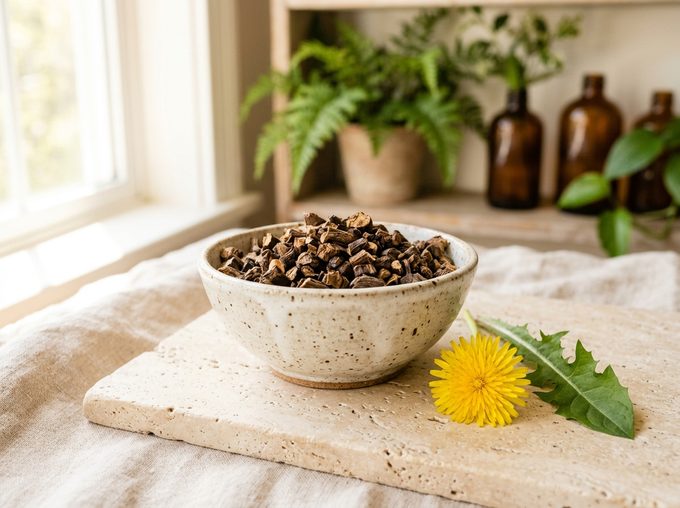
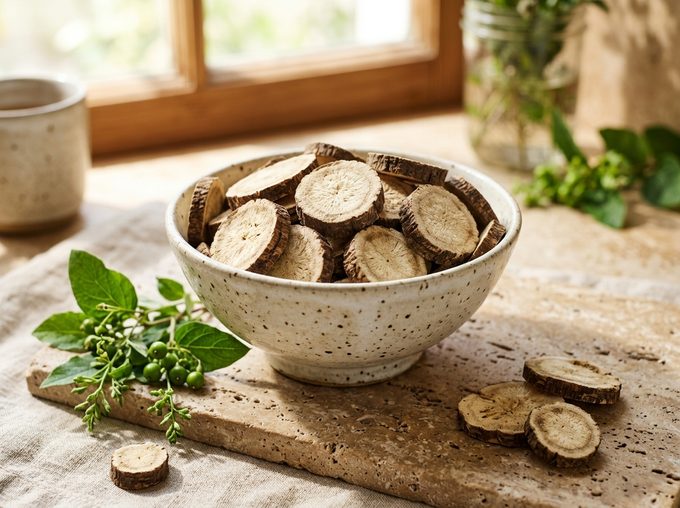
Dried burdock root pieces for simmering, decoctions, and jars.
A little about burdock root.
The plant
Mildly sweet, starchy, and artichoke-earthy with very gentle bitterness. Native to Temperate Eurasia (Asteraceae (Daisy Family)).
The forms
Most often prepared as a deep alterative root decoction using 4 g – 6 g (1 tbsp dried cut root discs/nibs) at 205°F–212°F covered simmer (Simmer 20–25 min in 12 oz water).
Before you choose
Check the label for the Latin name (Arctium lappa), and choose the form that suits your cupboard.
Traditional uses & research +
Botanical taxonomy: Arctium lappa (Asteraceae (Daisy Family)) · Tradition: Digestive & Carminative · Key constituents: Inulin, Arctigenin, Chlorogenic acid, Polyacetylenes.
Curated collections: Digestive Bitters & Warming Spices · Seasonal Harvest & Winter Apothecary · Seasonal almanac: March Almanac (Early Spring Mineral Greens & Bitters) · October Almanac (First-Frost Taproots & Rosehips).
Traditional background: Famous both as the traditional British 'Dandelion and Burdock' fermented country drink and as the prized culinary root vegetable Gobo in Japan, its hooked seed burrs also inspired the invention of Velcro in 1941.
Everyday & kitchen uses: Simmered with dandelion root, ginger, and sarsaparilla or cinnamon into earthy root decoctions and savory soups.
Standard preparation methods (compare all 50 steeping temperatures):
- Deep Alterative Root Decoction (4 g – 6 g (1 tbsp dried cut root discs/nibs) at 205°F–212°F covered simmer): Simmer 20–25 min in 12 oz water
- Dandelion-Burdock Root Broth (1 tbsp burdock + 1 tsp dandelion root + 3 slices fresh ginger at Low simmer): Simmer 25 min
- Culinary Kinpira Gobo (Fresh Root) (Julienne fresh peeled root; soak 5 min in cold water at Skillet sauté in sesame oil + tamari): Sauté 8 min until tender-crisp
Cautions & interactions +
Who should use caution: Extremely safe—burdock taproot is eaten daily as a staple root vegetable (Gobo) across Japan, Korea, and Taiwan. Avoid only if you have a severe Asteraceae family allergy, and avoid high-dose concentrated extracts during pregnancy.
Species & lookalike verification: CRITICAL FORAGING SAFETY: Cultivated Greater Burdock (Arctium lappa, known in Japan as Gobo) has a long, slender, crisp taproot and hollow lower leaf stalks. In the wild, young first-year Burdock rosettes grow in the same damp woodland edges as Deadly Nightshade (Atropa belladonna) and Foxglove (Digitalis purpurea)—historic cases of belladonna root contaminating wild-dug burdock are why you should only buy cultivated organic Arctium lappa root.
Cupboard storage (amber glass guide): Keep dried root slices in a dry mason jar; inulin-rich roots can soften if exposed to damp air.
Sources & further reading +
Is Burdock Root the same plant as the vegetable 'Gobo' in Japanese cooking?
Yes! Arctium lappa is the exact same plant. While Western herbalists dry the sliced taproot for slow-simmered alterative teas and traditional British 'Dandelion & Burdock' fermented sodas, Japanese cuisine harvests the crisp, 2-foot-long first-year root fresh as Gobo.
How did Burdock inspire the invention of Velcro?
In 1941, Swiss engineer George de Mestral returned from a hunting walk in the Alps and examined the stubborn burdock seed heads (burs) clinging to his wool trousers and his dog's coat under a microscope. He discovered hundreds of tiny elastic hooks that latched onto fabric loops—inspiring hook-and-loop fasteners.
Does Burdock Root contain prebiotic fiber?
Yes—dried burdock root contains 30% to 45% inulin and oligofructose, soluble prebiotic fibers that dissolve into a 20-minute decoction to give the tea a naturally smooth, slightly sweet body.
What herbs pair best with Burdock Root in a daily tea?
Roasted dandelion root, sarsaparilla, licorice root, ginger, and cinnamon pair seamlessly with burdock's earthy-sweet profile.
Companion Moss & Thyme guides & tools:
- Herbarium Journal: Covered Infusions vs. Simmered Decoctions →
- Equipment Guide: Best Mortars, Pestles & Apothecary Grinders →
- Interactive Calculator: Infusion vs. Decoction & Safety Checker →
Botanical references:
- Royal Botanic Gardens, Kew — Plants of the World Online: Arctium lappa Taxonomic Record ↗
- PubChem / NIH National Library of Medicine: Phytochemical Profile (Inulin) ↗
- European Medicines Agency (EMA) HMPC & German Commission E Herbal Monographs.
See the herb in context.
Watch our video guide The Most Powerful Herbs in the World, Explained and explore the plants it introduces.
Explore another herb.