Bay Laurel
Noble Evergreen Wreath Leaf of Classical Antiquity.
Explore the common forms, learn a little about the plant, and choose what suits your cupboard.
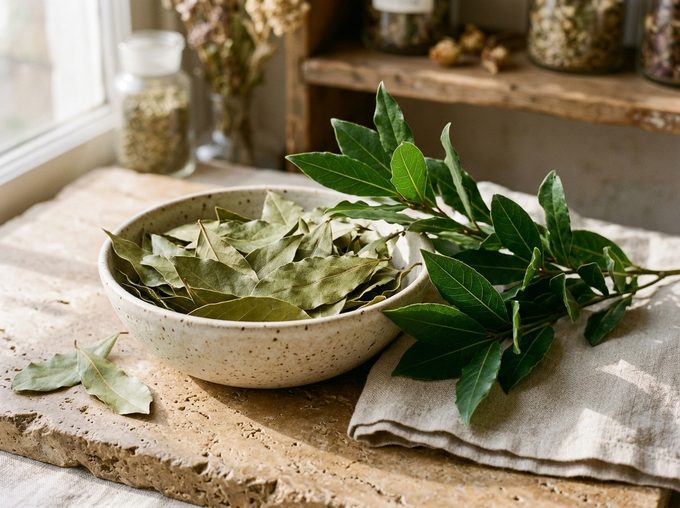
Whole cut-and-sifted bay laurel leaves for steeping and blending.
A little about bay laurel.
The plant
Deeply balsamic, woody, and savory-herbal with layered notes of eucalyptus, clove, pine, and nutmeg. Native to Mediterranean Region (Lauraceae (Laurel Family)).
The forms
Most often prepared as a simmered leaf tisane using 2–3 whole dried leaves (cracked in half) per 10 oz water at 205°F–212°F gentle simmer (Simmer covered 10–12 min, then let stand 5 min).
Before you choose
Check the label for the Latin name (Laurus nobilis), and choose the form that suits your cupboard.
Traditional uses & research +
Botanical taxonomy: Laurus nobilis (Lauraceae (Laurel Family)) · Tradition: Volatile Aromatics · Key constituents: 1,8-Cineole, Eugenol, Linalool, Costunolide.
Curated collections: Mediterranean Culinary & Hearth Herbs · Digestive Bitters & Warming Spices · Seasonal almanac: June Almanac (Midsummer Blossoms) · October Almanac (Autumn Roots).
Traditional background: Sacred to Apollo in classical Greece and Rome, crowns of Laurus nobilis were awarded to poets, scholars, and victors—giving rise to the terms 'poet laureate' and 'baccalaureate'.
Everyday & kitchen uses: Simmered whole in broths, braises, and spiced apple ciders, or tucked into pantry flour and grain canisters as a traditional aromatic leaf.
Standard preparation methods (compare all 50 steeping temperatures):
- Simmered Leaf Tisane (2–3 whole dried leaves (cracked in half) per 10 oz water at 205°F–212°F gentle simmer): Simmer covered 10–12 min, then let stand 5 min
- Savory Stock & Broth Foundation (2 whole dried leaves per quart of stock at Low stovetop simmer): Simmer 45–90 min; always remove whole leaves before serving
- Pantry Grain Weevil Deterrent (1 whole aromatic dried leaf tucked inside flour/rice jars at Dry ambient storage): Replace leaf every 6 months
Cautions & interactions +
Who should use caution: Always remove whole bay leaves from soups and teas before serving—even after hours of boiling, the stiff leathery midrib does not soften and can scratch or lodge in the throat or digestive tract.
Species & lookalike verification: CRITICAL IDENTIFICATION: True Mediterranean Bay Laurel (Laurus nobilis, family Lauraceae) has a milder, rounded balsamic aroma and leaves about 2–3 inches long. California Bay Laurel (Umbellularia californica) has narrower, lance-shaped leaves that are 3x more pungent due to umbellulone (which can cause a 'bay headache' if inhaled deeply). Never confuse edible Laurus nobilis with toxic ornamental laurels such as Cherry Laurel (Prunus laurocerasus, contains cyanide compounds), Mountain Laurel (Kalmia latifolia), or Oleander (Nerium oleander).
Cupboard storage (amber glass guide): Store whole unbroken leaves flat in an airtight tin; replace yearly as olive-green leaves fade to tan.
Sources & further reading +
Do bay leaves actually add flavor, or is it a myth?
It is only a myth if you use 5-year-old bleached bay leaves that have lost all their volatile oils. Freshly cured olive-green Laurus nobilis contains over 40 aromatic compounds—led by 1,8-cineole, eugenol, and linalool—that release slowly over 30–60 minutes to replace flat heaviness in soups with a clean, woodsy depth.
What is the difference between Turkish (Mediterranean) bay leaves and California bay leaves?
Turkish bay (Laurus nobilis) is oval, wider, and has a gentle, complex clove-nutmeg-pine aroma. California bay (Umbellularia californica) is long, narrow, and intensely eucalyptus-menthol strong; if a recipe calls for 2 Turkish bay leaves, use only 1/2 of a California bay leaf.
Why can't you eat a whole cooked bay leaf?
Bay laurel is a tough evergreen tree leaf reinforced with rigid lignin fibers. Unlike spinach or basil, cooking does not break down its sharp edges, so swallowing a whole leaf shard poses a physical scratch hazard to the digestive tract.
How do you make traditional bay leaf and cinnamon tea?
Crack 2 whole Turkish bay leaves and 1 Ceylon cinnamon quill into 10 oz of cold water, bring to a covered simmer for 10 minutes, strain into a mug, and finish with a slice of lemon.
Companion Moss & Thyme guides & tools:
- Herbarium Journal: Evening Botanical Tea Rituals & Blending →
- Equipment Guide: Best Loose-Leaf Tea Infusers & Gooseneck Kettles →
- Interactive Calculator: Interactive 3-Part Tea Blend Synergy Builder →
Botanical references:
- Royal Botanic Gardens, Kew — Plants of the World Online: Laurus nobilis Taxonomic Record ↗
- PubChem / NIH National Library of Medicine: Phytochemical Profile (1) ↗
- European Medicines Agency (EMA) HMPC & German Commission E Herbal Monographs.
See the herb in context.
Watch our video guide The Most Powerful Herbs in the World, Explained and explore the plants it introduces.
Explore another herb.