Passionflower
Maypop Vine • Ornate Purple Blossom of Quiet Evening Reflection.
Explore the common forms, learn a little about the plant, and choose what suits your cupboard.
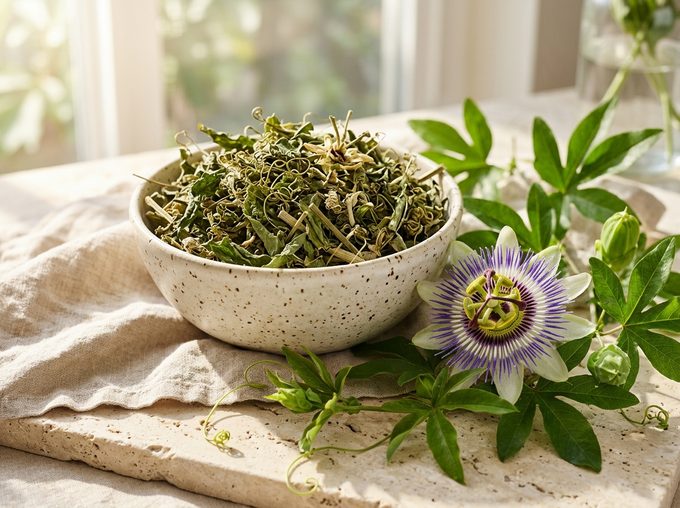
Whole dried passionflower flowers for steeping and infusions.
A little about passionflower.
The plant
Mild, grassy, and softly earthy-herbaceous with subtle hay-like notes. Native to Southeastern North America (Passifloraceae).
The forms
Most often prepared as a evening aerial infusion using 2 g – 3 g (1.5 tbsp cut leaf, stem & flower) at 200°F (93°C) (10–12 min covered).
Before you choose
Check the label for the Latin name (Passiflora incarnata), and choose the form that suits your cupboard.
Traditional uses & research +
Botanical taxonomy: Passiflora incarnata (Passifloraceae) · Tradition: Calming Nervines · Key constituents: Vitexin, Isovitexin, Chrysin, Harmala trace alkaloids.
Curated collections: Evening Calm & Bedtime Infusions · Seasonal almanac: July Almanac (High-Summer Mint, Basil & Meadow Nervines).
Traditional background: Indigenous peoples of the American Southeast valued the native maypop vine (Passiflora incarnata) long before Spanish missionaries named its elaborate radial crown.
Everyday & kitchen uses: Steeped as an evening herbal tea or prepared as a botanical glycerite and tincture alongside skullcap and valerian.
Standard preparation methods (compare all 50 steeping temperatures):
- Evening Aerial Infusion (2 g – 3 g (1.5 tbsp cut leaf, stem & flower) at 200°F (93°C)): 10–12 min covered
- Synergistic Sleep Tisane (1 tbsp passionflower + 1 tbsp chamomile + 1 tsp lemon balm at 200°F (93°C)): 10 min covered
- Apothecary Liquid Extract (1:5 dried aerial parts in 45% alcohol at Dark glass maceration): Steep 4 weeks, shaking daily
Cautions & interactions +
Who should use caution: Avoid during pregnancy (some constituents have demonstrated uterine stimulant activity in animal models). Because passionflower has mild calming activity, avoid combining concentrated extracts with prescription sedatives or sleep medications without medical guidance.
Species & lookalike verification: Specify Purple Passionflower / Maypop (Passiflora incarnata), native to the southeastern United States, which is the official pharmacopoeial species studied for chrysin, vitexin, and isovitexin flavonoids. Ornamental Blue Passionflower (Passiflora caerulea) and tropical Passionfruit vine (Passiflora edulis) have different alkaloid/glycoside profiles; P. caerulea foliage contains higher cyanogenic glycosides when raw.
Cupboard storage (amber glass guide): Store cut-and-sifted aerial parts in a cool, dark cabinet.
Sources & further reading +
Is Passionflower made from the passionfruit flower?
Commercial passionfruit comes primarily from Passiflora edulis, a tropical South American species. Apothecary passionflower tea is harvested from Passiflora incarnata (the hardy North American 'Maypop' vine), whose aerial leaves, stems, and blossoms contain the highest levels of vitexin and isovitexin flavonoids.
What does passionflower tea taste like on its own?
On its own, Passiflora incarnata tastes mild, green, and slightly hay-like—similar to a light green rooibos or oatstraw. It has almost no bitterness, which makes it an effortless base to pair with lemon balm, lavender, or chamomile.
Which part of the passionflower plant is used in herbalism?
Despite the name, herbalists harvest the entire above-ground ('aerial') vine during the flowering and early fruiting stage—including the three-lobed leaves, stems, coiled tendrils, and blossoms.
When is passionflower most commonly steeped?
Passionflower is traditionally favored by people who experience 'circular thinking' or mental chatter at bedtime, steeped 30–45 minutes before lights out.
Companion Moss & Thyme guides & tools:
- Herbarium Journal: Evening Botanical Tea Rituals & Blending →
- Equipment Guide: Best Loose-Leaf Tea Infusers & Gooseneck Kettles →
- Interactive Calculator: Interactive 3-Part Tea Blend Synergy Builder →
Botanical references:
- Royal Botanic Gardens, Kew — Plants of the World Online: Passiflora incarnata Taxonomic Record ↗
- PubChem / NIH National Library of Medicine: Phytochemical Profile (Vitexin) ↗
- European Medicines Agency (EMA) HMPC & German Commission E Herbal Monographs.
See the herb in context.
Watch our video guide The Most Powerful Herbs in the World, Explained and explore the plants it introduces.
Explore another herb.