Lavender
True Culinary Lavender Buds of Provence & English Gardens.
Explore the common forms, learn a little about the plant, and choose what suits your cupboard.
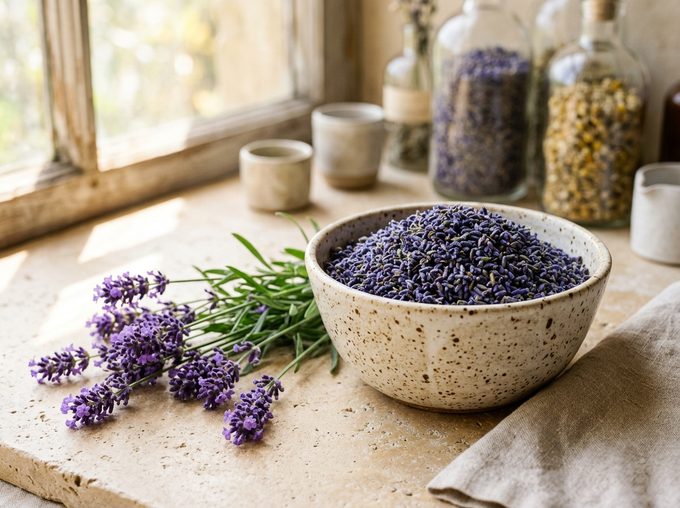
Whole dried lavender flowers for steeping and infusions.
A little about lavender.
The plant
Sweet, herbaceous-floral, and softly balsamic with bright bergamot-citrus linalool notes and minimal camphor bite. Native to Western Mediterranean & Provence (Lamiaceae (Mint Family)).
The forms
Most often prepared as a single-note floral infusion using 1 g (1/2 to 1 level tsp dried buds) at 195°F (90°C) (4–6 min covered (more buds can taste soapy)).
Before you choose
Check the label for the Latin name (Lavandula angustifolia), and choose the form that suits your cupboard.
Traditional uses & research +
Botanical taxonomy: Lavandula angustifolia (Lamiaceae (Mint Family)) · Tradition: Calming Nervines · Key constituents: Linalool, Linalyl acetate, Lavandulol, Tannins.
Curated collections: Evening Calm & Bedtime Infusions · Ruby Berries & Floral Tisanes · Mediterranean Culinary & Hearth Herbs · Beginner's Home Apothecary Starter Shelf · Seasonal almanac: June Almanac (Midsummer Lavender & Sunlit Blossoms).
Traditional background: From the Latin lavare ('to wash'), lavender scented Roman bathhouses, Renaissance linen chests, and Victorian apothecary waters for centuries.
Everyday & kitchen uses: Blended in small proportions into Earl Grey or chamomile teas, baked into shortbread and honey syrups, or sewn into bedside linen sachets.
Standard preparation methods (compare all 50 steeping temperatures):
- Single-Note Floral Infusion (1 g (1/2 to 1 level tsp dried buds) at 195°F (90°C)): 4–6 min covered (more buds can taste soapy)
- Chamomile-Lavender Bedtime Blend (1.5 tbsp chamomile + 1/2 tsp lavender buds + 1 tsp lemon balm at 195°F–200°F (90°C–93°C)): 6 min covered
- Culinary Herbes de Provence / Shortbread (1 tsp culinary buds finely ground with 1/2 cup cane sugar at Dry culinary baking): Sift out any woody calyx husks before baking
Cautions & interactions +
Who should use caution: Culinary dried buds in tea and food are gentle and well tolerated. Pure distilled lavender essential oil is for aromatic diffuser or diluted topical use only.
Species & lookalike verification: CRITICAL CULINARY DISTINCTION: Always verify 'English Lavender' / 'True Lavender' (Lavandula angustifolia, cultivars such as 'Munstead', 'Hidcote', or 'Royal Velvet') for tea and baking. Commercial craft lavender is often Lavandin (Lavandula × intermedia, such as 'Grosso' or 'Provence'), a high-yield hybrid that contains 7%–12% camphor—making tea or cookies taste harsh, medicinal, and soapy.
Cupboard storage (amber glass guide): Store in dark glass away from humidity to preserve the royal blue-violet color of the calyx buds.
Sources & further reading +
Why does my lavender tea or baking taste like soap?
Two reasons: either the lavender is Lavandin (Lavandula × intermedia, grown for soap and sachets because it is high in camphor) rather than low-camphor culinary Lavandula angustifolia, or you used too much. Even with true culinary lavender, 1/2 teaspoon per 8 oz cup is plenty.
Is 'English Lavender' different from 'French Lavender'?
Yes. 'English Lavender' (Lavandula angustifolia, actually native to the high mountains of the western Mediterranean) is the sweet, low-camphor culinary species. 'French/Spanish Lavender' (Lavandula stoechas, with 'rabbit-ear' bracts on top) is very high in camphor and fenchone and is not used for culinary tea.
How do you make café-style Lavender Simple Syrup at home?
Simmer 1 cup water and 1 cup sugar until dissolved, turn off the heat, stir in 1.5 tablespoons of culinary Lavandula angustifolia buds, cover the pot for 15 minutes, and strain into a glass bottle.
Why does lavender syrup look pale beige instead of purple?
Dried lavender buds release a pale golden-amber infusion on their own. If you want a natural pastel-violet hue without artificial dye, add 3 dried hibiscus petals or 2 butterfly pea flowers while steeping.
Companion Moss & Thyme guides & tools:
- Herbarium Journal: Evening Botanical Tea Rituals & Blending →
- Equipment Guide: Best Loose-Leaf Tea Infusers & Gooseneck Kettles →
- Interactive Calculator: Interactive 3-Part Tea Blend Synergy Builder →
Botanical references:
- Royal Botanic Gardens, Kew — Plants of the World Online: Lavandula angustifolia Taxonomic Record ↗
- PubChem / NIH National Library of Medicine: Phytochemical Profile (Linalool) ↗
- European Medicines Agency (EMA) HMPC & German Commission E Herbal Monographs.
See the herb in context.
Watch our video guide The Most Powerful Herbs in the World, Explained and explore the plants it introduces.
Explore another herb.