Calendula Blossom
Pot Marigold • Resinous Solar Gold Petals of Salves & Broths.
Explore the common forms, learn a little about the plant, and choose what suits your cupboard.
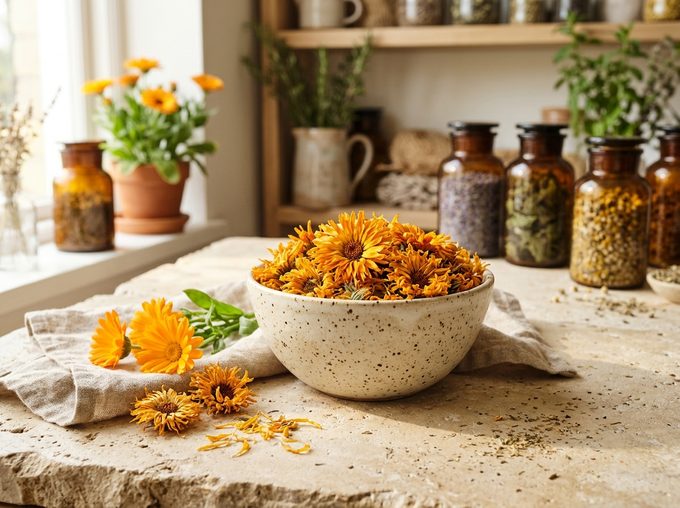
Whole dried calendula blossom flowers for steeping and infusions.
A little about calendula blossom.
The plant
Mildly earthy, resinous-floral, slightly peppery, and gently bittersweet with a warm saffron-gold color. Native to Southern Europe & Mediterranean (Asteraceae (Daisy Family)).
The forms
Most often prepared as a whole-blossom lymphatic/digestive tea using 2 g (2 to 3 whole dried flower heads or 1.5 tbsp petals) at 200°F (93°C) (8–10 min covered).
Before you choose
Check the label for the Latin name (Calendula officinalis), and choose the form that suits your cupboard.
Traditional uses & research +
Botanical taxonomy: Calendula officinalis (Asteraceae (Daisy Family)) · Tradition: Soothing Demulcents · Key constituents: Triterpenoid esters (Faradiol), Lutein, Beta-carotene, Resins.
Curated collections: Ruby Berries & Floral Tisanes · Beginner's Home Apothecary Starter Shelf · Seasonal almanac: May Almanac (May Blossom & Early Meadow Florals) · June Almanac (Midsummer Lavender & Sunlit Blossoms).
Traditional background: Named from the Latin kalendae because it blooms on the first day of almost every month in mild climates, calendula was historically called 'Poor Man's Saffron' for coloring medieval soups and cheeses.
Everyday & kitchen uses: Infused into olive or jojoba oil for botanical balms and salves, scattered into winter soups, or steeped with chamomile and mint.
Standard preparation methods (compare all 50 steeping temperatures):
- Whole-Blossom Lymphatic/Digestive Tea (2 g (2 to 3 whole dried flower heads or 1.5 tbsp petals) at 200°F (93°C)): 8–10 min covered
- Traditional Golden Infused Skin Oil (Fill dry mason jar 2/3 full with whole dried flowers; cover completely with olive/jojoba oil at Warm dark cabinet (or 110°F bath)): Infuse 3–4 weeks (ensure flowers are 100% bone-dry so oil never molds)
- Soothing Botanical Skin Wash (2 tbsp whole calendula + 1 tbsp chamomile steeped in 1 cup water at Steep 15 min, cool completely): Use as a gentle cooled compress
Cautions & interactions +
Who should use caution: Calendula officinalis belongs to the Asteraceae (daisy) family; individuals with severe ragweed/daisy allergies should test a small amount first. Internally, concentrated calendula infusions are traditionally avoided during pregnancy due to mild emmenagogue history (topical calendula salves and oils remain widely used).
Species & lookalike verification: CRITICAL BOTANICAL DISTINCTION: True Pot Marigold is Calendula officinalis (whose sticky green resinous involucral bracts and golden-orange ray florets are culinary and apothecary staples). Do NOT confuse Calendula officinalis with French or African Garden Marigolds (Tagetes patula or Tagetes erecta)—Tagetes marigolds have divided fern-like leaves, a pungent musky-skunky smell, and contain phototoxic thiophenes not suited for standard herbal tea.
Cupboard storage (amber glass guide): Store whole dried flower heads in dark glass; orange and yellow carotenoids bleach rapidly in window light.
Sources & further reading +
Is Calendula the same thing as the Marigolds sold in garden center six-packs?
Usually not! Most bedding marigolds sold for pest control in vegetable gardens belong to the genus Tagetes (French or African Marigolds), which have a strong pungent odor and divided leaves. True apothecary Calendula is Calendula officinalis ('Pot Marigold'), which has paddle-shaped fuzzy leaves and sticky, resinous orange-gold blossoms.
Why should you buy whole Calendula flower heads instead of just loose petals?
When you touch the green base (calyx/involucre) underneath a fresh calendula flower, your fingers turn tacky with aromatic resin. That green base holds the highest concentration of anti-inflammatory triterpenoid esters (faradiol monoesters) and volatile oils; loose petals alone provide mostly lutein color.
Why did my homemade Calendula infused oil grow mold?
Fresh calendula flower heads have thick, fleshy green centers that hold surprising amounts of hidden moisture even when the outer petals feel dry. For oil infusions, always use thoroughly dehydrated calendula flowers that snap crisply at the green center.
Why was Calendula called 'Pot Marigold' and 'Poor Man's Saffron'?
In medieval European kitchens, cooks dropped whole dried calendula blossoms into winter soup pots ('pot-herbs') and churned butter to impart a rich golden-saffron color (from beta-carotene, lutein, and lycopene) at a fraction of the cost of true Crocus sativus saffron.
Companion Moss & Thyme guides & tools:
- Herbarium Journal: Evening Botanical Tea Rituals & Blending →
- Equipment Guide: Best Loose-Leaf Tea Infusers & Gooseneck Kettles →
- Interactive Calculator: Interactive 3-Part Tea Blend Synergy Builder →
Botanical references:
- Royal Botanic Gardens, Kew — Plants of the World Online: Calendula officinalis Taxonomic Record ↗
- PubChem / NIH National Library of Medicine: Phytochemical Profile (Triterpenoid esters (Faradiol)) ↗
- European Medicines Agency (EMA) HMPC & German Commission E Herbal Monographs.
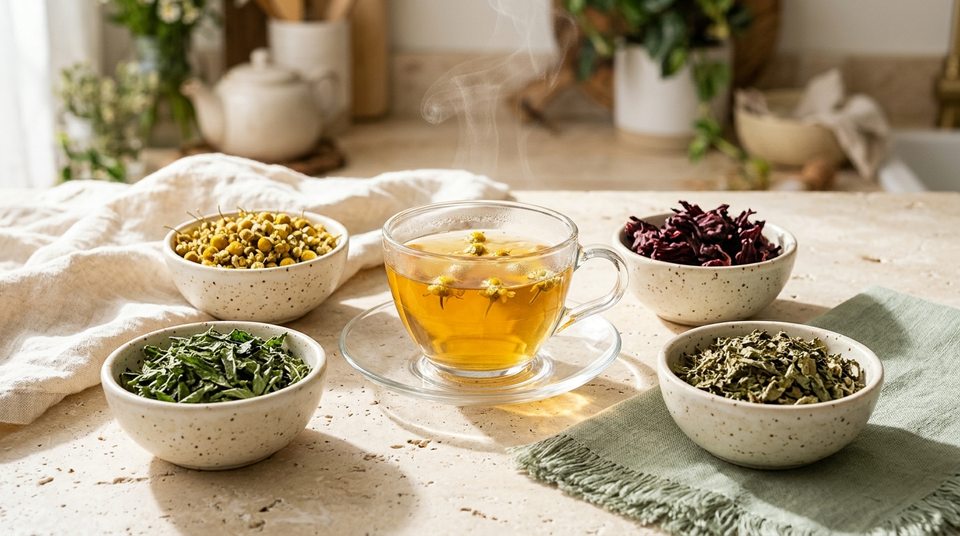
See the herb in context.
Watch our video guide The Most Powerful Herbs in the World, Explained and explore the plants it introduces.
Explore another herb.